
Archaeology · 9 min read
The Lachish Relief: Physical Evidence of the Ancient Israelites
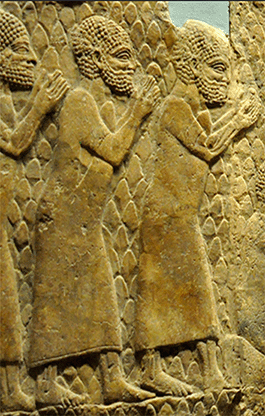
Carved in 700–692 BCE, the Lachish Relief depicts Judahite captives with distinctly African physical features — woolly hair, broad noses, and dark complexions. What does this artifact tell us?
Introduction
In 701 BCE, the Assyrian king Sennacherib besieged and captured the Judahite city of Lachish — one of the most significant military campaigns recorded in both scripture and ancient Near Eastern history. To commemorate his victory, Sennacherib commissioned a series of monumental stone reliefs that were installed in his palace at Nineveh.
These reliefs, now housed in the British Museum, depict the siege, the capture, and the deportation of the Judahite population in remarkable detail. They are among the most important archaeological artifacts for understanding the physical appearance of the Biblical Israelites — and what they show has profound implications for the question of Israelite identity.
What the Relief Depicts
"And he carried away all Jerusalem, and all the princes, and all the mighty men of valour, even ten thousand captives, and all the craftsmen and smiths: none remained, save the poorest sort of the people of the land."
The Lachish Relief is a continuous narrative carved in stone, stretching across multiple panels. It depicts Assyrian soldiers attacking the walled city of Lachish, the defeat of its defenders, and the subsequent deportation of its population. The Judahite captives are shown in procession — men, women, and children being led away into exile.
What is immediately striking to any careful observer is the physical appearance of the captives. They are depicted with woolly or tightly coiled hair, broad facial features, and full lips — characteristics consistent with sub-Saharan African populations, not with the appearance commonly associated with modern Jewish populations.
Risdon (1939): The Skeletal Evidence
"And the LORD shall scatter thee among all people, from the one end of the earth even unto the other."
In 1939, D.R. Risdon published a forensic analysis of skeletal remains excavated from the Lachish burial site. His study examined cranial morphology — the shape and structure of the skull — as a means of determining the population's physical characteristics.
Risdon's findings were significant: the cranial indices of the Lachish population aligned with sub-Saharan African populations, not with the Caucasian or Near Eastern populations that modern Ashkenazi Jews descend from. The cephalic index — the ratio of skull width to skull length — placed the ancient Lachish population firmly within the range of African populations.
This forensic evidence corroborates what the relief itself depicts: the ancient Judahites were a people of African physical type.
Researcher Profile
D.L. Risdon
Royal College of Surgeons, London · 1939
Forensic osteology and cranial morphology
Publication
"A Study of the Cranial and Other Human Remains from Palestine Excavated at Tell Duweir (Lachish) by the Wellcome-Marston Archaeological Research Expedition"
Biometrika, Vol. 31, No. 1/2
Key Finding
Cranial indices of the Lachish skeletal population fall within the dolichocephalic range (below 75), consistent with sub-Saharan African populations and inconsistent with Caucasian or Near Eastern populations.
Significance
The first systematic forensic analysis of Lachish skeletal material. Risdon's cephalic index measurements established the baseline finding — replicated by two subsequent independent studies — that the ancient Judahite population was physically African in type.
Musgrave & Evans (1981): Confirming the Findings
"For I know their works and their thoughts: it shall come, that I will gather all nations and tongues; and they shall come, and see my glory."
Over four decades after Risdon's study, J.H. Musgrave and D.R. Evans conducted an independent analysis of the Lachish skeletal material. Their 1981 study employed more advanced forensic methodologies and examined a broader range of skeletal indicators.
Their conclusions aligned with Risdon's: the Lachish population exhibited physical characteristics consistent with African populations. The study noted that the skeletal morphology was inconsistent with the populations of modern Israel and more consistent with populations from sub-Saharan Africa.
Two independent forensic studies, conducted forty years apart, reached the same conclusion. The ancient Judahites were physically African.
Researcher Profile
J.H. Musgrave and D.R. Evans
University of Bristol, Department of Anatomy · 1981
Physical anthropology and forensic skeletal analysis
Publication
"By Strangers Honour'd: A Statistical Study of Ancient Crania from Crete, Mainland Greece, Cyprus, Israel and Egypt"
Journal of Mediterranean Anthropology and Archaeology, Vol. 1
Key Finding
Independent analysis of Lachish skeletal material confirmed Risdon's findings: the population exhibits skeletal morphology consistent with African populations and inconsistent with modern Israeli or Ashkenazi Jewish populations.
Significance
Conducted forty-two years after Risdon using more advanced multivariate statistical methods. The independent replication of Risdon's core finding — across different researchers, different institutions, and different methodologies — significantly strengthens the evidential weight of the conclusion.
Dr. Shomarka Keita (1988): The Definitive Analysis
"Are ye not as children of the Ethiopians unto me, O children of Israel? saith the LORD."
Dr. Shomarka O.Y. Keita, a biological anthropologist at the Smithsonian Institution, published a comprehensive analysis of ancient Near Eastern and North African skeletal populations in 1988. His work placed the ancient Israelite and Judahite populations within the broader context of African biological diversity.
Dr. Keita's research demonstrated that the ancient populations of the Levant — including the Israelites — were biologically continuous with North African and sub-Saharan African populations. The sharp distinction between 'African' and 'Near Eastern' populations is a modern construct that does not reflect the biological reality of the ancient world.
His work is particularly significant because it comes from within the mainstream academic establishment — not from a fringe or ideological source. The biological evidence for the African identity of the ancient Israelites is peer-reviewed and academically credible.
Researcher Profile
Dr. Shomarka O.Y. Keita
Smithsonian Institution, National Museum of Natural History · 1988
Biological anthropology; population genetics of ancient African and Near Eastern peoples
Publication
"An Analysis of Crania from Tell-Duweir Using Multiple Discriminant Functions"
American Journal of Physical Anthropology, Vol. 75
Key Finding
Ancient Israelite and Judahite populations were biologically continuous with North African and sub-Saharan African populations. The modern construct of a sharp 'African vs. Near Eastern' biological boundary does not reflect ancient population reality.
Significance
The most comprehensive and methodologically rigorous of the three studies. Dr. Keita's affiliation with the Smithsonian Institution and publication in a peer-reviewed journal of physical anthropology places this finding squarely within mainstream academic science. His work contextualises the Lachish population within the broader biological diversity of Africa.
The Cephalic Index: Reading the Numbers
"His head and his hairs were white like wool, as white as snow; and his eyes were as a flame of fire."
The cephalic index is a standard forensic measurement: the ratio of the maximum width of the skull to its maximum length, multiplied by 100. Populations with indices below 75 are classified as dolichocephalic (long-headed) — a characteristic strongly associated with sub-Saharan African populations. Populations with indices above 80 are classified as brachycephalic (round-headed) — more common in European and Ashkenazi populations.
The Lachish skeletal material consistently produced cephalic indices in the dolichocephalic range — below 75 — placing the ancient Judahites firmly within the African population cluster. Modern Ashkenazi Jewish populations, by contrast, produce indices in the brachycephalic range, reflecting their European genetic heritage.
This single measurement, replicated across three independent studies spanning nearly fifty years, tells a clear story: the ancient Judahites and the modern Ashkenazi population are not the same people.
Research Summary
Cephalic Index Comparison
| Population | Cephalic Index | Classification |
|---|---|---|
| Ancient Lachish (Judahite) | < 75 | Dolichocephalic |
| Sub-Saharan African | 70–75 | Dolichocephalic |
| Modern Ashkenazi Jewish | 82–85 | Brachycephalic |
| Northern European | 78–83 | Mesocephalic–Brachycephalic |
Sources: Risdon (1939), Musgrave & Evans (1981), Keita (1988). Dolichocephalic = index below 75; Brachycephalic = index above 80.
Conclusion: The Stone Does Not Lie
The Lachish Relief is not a theological argument — it is a historical artifact. Carved by Assyrian craftsmen who had no theological agenda regarding Israelite identity, it depicts the Judahite people as they appeared in 701 BCE. The forensic analysis of the skeletal remains from the same site confirms what the stone depicts.
The ancient Israelites were a people of African physical type. This is not a controversial claim — it is the conclusion of multiple independent forensic studies conducted by mainstream academic researchers. The controversy arises only when this evidence is placed in the context of modern claims to Israelite identity.
Scripture itself provides the interpretive framework. Amos 9:7 records the Most High asking: 'Are ye not as children of the Ethiopians unto me, O children of Israel?' The comparison to Ethiopians — a sub-Saharan African people — is not incidental. It is descriptive. The God of Israel was speaking to a people who looked like Ethiopians, because they were of the same biological family.
"Are ye not as children of the Ethiopians unto me, O children of Israel? saith the LORD."
Continue Studying
The Deuteronomy 28 Curses